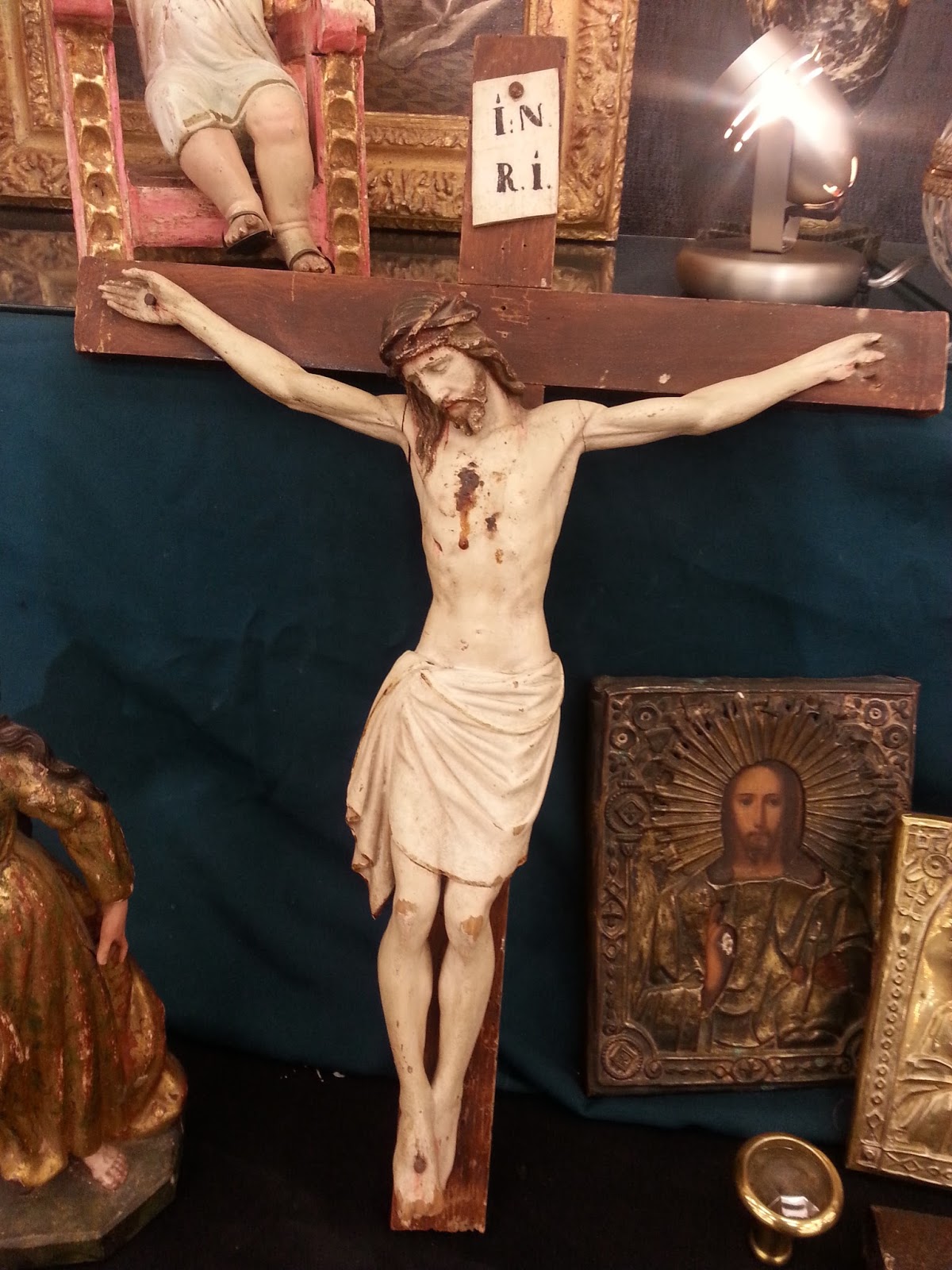
Showing posts with label Jesus. Show all posts

Sunday, April 12, 2020

Resurrection Sunday: He Is Alive!!

But on the first day of the week, at early dawn, they came to the tomb bringing the spices which they had prepared. And they found the stone rolled away from the tomb, but when they entered, they did not find the body of the Lord Jesus. While they were perplexed about this, behold, two men suddenly stood near them in dazzling clothing; and as the women were terrified and bowed their faces to the ground, the men said to them, ‘Why do you seek the living One among the dead?  He is not here, but He has risen. Remember how He spoke to you while He was still in Galilee, saying that the Son of Man must be delivered into the hands of sinful men, and be crucified, and the third day rise again” {Luke 24: 1-7 NASB}.


Blessed be the God and Father of our Lord Jesus Christ, who according to His great mercy has caused us to be born again to a living hope through the resurrection of Jesus Christ from the dead” (1 Pet. 1:3 NASB)


The angel said to the women, ‘Do not be afraid; for I know that you are looking for Jesus who has been crucified. He is not here, for He has risen, just as He said. Come, see the place where He was lying’” (Matt. 28:5-6 NASB)


Did today’s message inspire you? If you enjoyed it, will you share please? Graciously consider subscribing to the blog?

See my series on the Jesus and fulfilled prophecy here
See my series on A Protestant's View on Stations of the Cross for Lent here

Wednesday, February 26, 2020

Crucible Hill: A Lenten Devotion: That Stake of Wood

I have been writing as of late about Eve for a forthcoming publication and as I study and read Genesis 3: 15, the protoevangelium provokes me to reflect on the cross some thousands of years after Eden.


No theology is genuinely Christian which does not arise from and focus on the cross. – Martin Luther
Lent is now suddenly upon us and though I am not now of a denominational tradition that celebrates the liturgical calendar, I did as a child. I have a deep longing to study and keep many of the traditions for myself, so on today, Ash Wednesday, I am well aware of my shortcomings and even more so, my sin. I reduce to ashes my dried palm from Palm Sunday last as I pray for His forgiveness, thankful that He died for them—for me.  

The cross is beautiful to me. What Christ endured on the cross for my sake is unfathomable, His love is unfathomable; His love, body, and blood poured out for me.

When I survey the wondrous cross On which the Prince of glory died, My richest gain I count but loss, And pour contempt on all my pride. Isaac Watts

Scripture—the blessed Holy Writ—makes clear that the death of Christ was necessary. It was part of God’s divine plan to redeem fallen, lost humanity. What a stiff-necked people we are in our fallenness. The Fall of creation was one of the most tragic occurrences the world has seen. It was a cosmic event of catastrophic proportions for which the remedy was beyond Adam and Eve’s power to repair. Though their sin was beyond their ability to mend God proved faithful in His promise to send the Messiah to restore what was broken.


 Therefore it was also credited to him as righteousness. Now not for his sake only was it written that it was credited to him, but for our sake also, to whom it will be credited, as those who believe in Him who raised Jesus our Lord from the dead, He who was delivered over because of our transgressions, and was raised because of our justification” {Rom. 4:22-25 NASB}.

The cross of Christ is beautiful to the sinner. That is why I have been troubled recently (I posted on social media) by the trend in some circles of Christians who assert that Jesus did not actually die and that the account of His crucifixion was only a metaphor. They further claim that the cross is repulsive and that only a mean and angry God would require the blood of His Son to satisfy His anger for sin. Further still, I can barely stand to write the accusation, they claim that this would be cosmic child abuse for Him to require such a gruesome sacrifice. 


 “So he then handed Him over to them to be crucified” {John 19:16 NASB}.

I wish there had been another way. I wish that Christ did not have to endure such suffering on my behalf. Jesus too, prayed that the cup would pass from Him {Matt. 26:29 NASB}. But He came to do the will of the Father, it was not cosmic child abuse, He was the perfect Lamb of God, taking on the sin of the world, to reconcile God’s beloved creation back to Himself. He did not choose some random person in which to impose the requirement of sin upon, rather He took the payment of such sin on Himself as well.

Then I said, ‘Behold, I have come (In the scroll of the book it is written of Me) To do Your will, O God.’” After saying above, ‘Sacrifices and offerings and whole burnt offerings and sacrifices for sin You have not desired, nor have You taken pleasure in them’ (which are offered according to the Law), then He said, ‘Behold, I have come to do Your will.’ He takes away the first in order to establish the second. By this will we have been sanctified through the offering of the body of Jesus Christ once for all” {Heb. 10:7-10}.

The crucifixion was Jesus’ voluntary act of laying down His life and taking it up again {Jn. 10:18}. No one takes it from Him. He came to do the will of the one who sent Him. He was not taken against His will; He was not martyred; He was not assassinated. He laid down His life. He did really die for our sins. I cannot imagine faithful followers of Jesus (who were martyred and died very brutal, gruesome deaths themselves) defending, suffering, and dying for a metaphorical cross. It is unimaginable. If He did not literally die, He did not literally rise from the dead. If He did not rise, our faith is in vain, and our message is useless, and then it would follow, so is our faith in Him{1 Cor. 15:14}.

First, as the Lord shall help me (for who shall describe the cross without the help of Him that hung upon it) what did Paul mean by the cross? Did he not include under this term, first, the fact of the cross; secondly, the doctrine of the cross, and thirdly, the cross of the doctrine? I think he meant, first of all, the fact of the cross. Our Lord Jesus Christ did really die upon a gallows, the death of a felon. He was literally put to death upon a tree, accursed in the esteem of men.” Charles Spurgeon, The Cross Our Glory, Sermon No. 1859.

God is Holy. Sin required a sacrifice. Jesus was that perfect one-time sacrifice. These are biblical truths. Where would we all be if not for the cross? How can one look upon it with such contempt? Such venom? Would it have been better for Him to annihilate us that we be separated and suffer apart from Him for eternity? Would it better for Him to allow us to live depraved? God let it not be so! He would not let it be. That is not gruesome, it is beautiful. I pray for those who are veiled from the truth of the cross and are a stumbling block and deceiving others by their teaching. God have mercy on them. Paul spoke about those who claim Christ did not die in his letter to the Corinthians,


For the word of the cross is foolishness to those who are perishing, but to us who are being saved it is the power of God. For it is written, ‘I will destroy the wisdom of the wise, And the cleverness of the clever I will set aside.’ Where is the wise man? Where is the scribe? Where is the debater of this age? Has not God made foolish the wisdom of the world? For since in the wisdom of God the world through its wisdom did not come to know God, God was well-pleased through the foolishness of the message preached to save those who believe. For indeed Jews ask for signs and Greeks search for wisdom; but we preach Christ crucified, to Jews a stumbling block and to Gentiles foolishness, but to those who are the called, both Jews and Greeks, Christ the power of God and the wisdom of God. Because the foolishness of God is wiser than men, and the weakness of God is stronger than men” {1 Cor. 1:22-25 NASB}.

We could summarize all of this background to Bonhoeffer’s Christology in one sentence, albeit a complex one: The cross was a stumbling block to the Romans; the cross was a stumbling block to the Nazis; the cross was a stumbling block to moderns; and—unless we are humbled and brought low beneath the cross to see its power and beauty—the cross can be a stumbling block to us.” 

Stephen J. Nichols, Bonhoeffer on the Christian Life: From the Cross, for the World


Did today’s message inspire you? If you enjoyed it, will you share please? Graciously consider subscribing to the blog?

See my series on the Jesus and fulfilled prophecy here
See my series on A Protestant's View on Stations of the Cross for Lent here

Sunday, April 1, 2018

Happy Resurrection Day! He Is Alive!


The Resurrection

But on the first day of the week, at early dawn, they came to the tomb bringing the spices which they had prepared. And they found the stone rolled away from the tomb, but when they entered, they did not find the body of the Lord Jesus. While they were perplexed about this, behold, two men suddenly stood near them in dazzling clothing; and as the women were terrified and bowed their faces to the ground, the men said to them, ‘Why do you seek the living One among the dead?  He is not here, but He has risen. Remember how He spoke to you while He was still in Galilee, saying that the Son of Man must be delivered into the hands of sinful men, and be crucified, and the third day rise again” {Luke 24: 1-7 NASB}.


Sunday, March 27, 2016

Jesus Is Risen!!!

Jesus is alive! Thank God He is Risen! This is the crux of His Passion story, If Christ had not risen, His death would mean nothing.

What shall we say then? Are we to continue in sin so that grace may increase? May it never be! How shall we who died to sin still live in it? Or do you not know that all of us who have been baptized into Christ Jesus have been baptized into His death? Therefore, we have been buried with Him through baptism into death, so that as Christ was raised from the dead through the glory of the Father, so we too might walk in newness of life. For if we have become united with Him in the likeness of His death, certainly we shall also be in the likeness of His resurrection, knowing this, that our old self was crucified with Him, in order that our body of sin might be done away with, so that we would no longer be slaves to sin; for he who has died is freed from sin. Now if we have died with Christ, we believe that we shall also live with Him, knowing that Christ, having been raised from the dead, is never to die again; death no longer is master over Him. For the death that He died, He died to sin once for all; but the life that He lives, He lives to God. Even so consider yourselves to be dead to sin, but alive to God in Christ Jesus.  

 Romans 6: 1-11 NASB

But if there be no resurrection of the dead, then is Christ not risen: And if Christ be not risen, then is our preaching vain, and your faith is also vain. 1 Corinthians 15: 13-14

But now is Christ risen from the dead, and become the first fruits of them that slept. 1 Corinthians 15: 20 NASB

If Christ had not risen, our faith would be in vain. The power that raised Jesus from the dead gives us the power to live. The death and resurrection is His whole Passion.
    
What does it mean for us as believers? What did the death and resurrection of Jesus Christ do for us? First, the Bible tells us that because Jesus died we have power over sin and death.

Therefore, having been justified by faith, we have peace with God through our Lord Jesus Christ, through whom also we have obtained our introduction by faith into this grace in which we stand; and we exult in hope of the glory of God.  Romans 5: 1-2 NASB

Much more then, having now been justified by His blood, we shall be saved from the wrath of God through Him. For if while we were enemies we were reconciled to God through the death of His Son, much more, having been reconciled, we shall be saved by His life.  And not only this, but we also exult in God through our Lord Jesus Christ, through whom we have now received the reconciliation.  Romans 5: 9-11 NASB

Because of the atonement, we have peace with God; Jesus is our advocate to the Father.

For there is one God, and one mediator also between God and men, the man Christ Jesus 1 Timothy 2: 5 NASB

But now He has obtained a more excellent ministry, by as much as He is also the mediator of a better covenant, which has been enacted on better promises. Hebrews 8:6 NASB

Jesus is all we need, He is the One that died and was raised up from the dead to reconcile us to the Father.

 In the Tabernacle in the wilderness, only the high priest could enter the Holy of Holies and atone for the people of Israel; not a Levite or any other priest.  In the New Testament, the Word tells us,


Therefore, He had to be made like His brethren in all things, so that He might become a merciful and faithful high priest in things pertaining to God, to make propitiation for the sins of the people. For since He Himself was tempted in that which He has suffered, He is able to come to the aid of those who are tempted. Hebrews 2: 17-18 NASB

but Jesus, on the other hand, because He continues forever, holds His priesthood permanently. Therefore, He is able also to save forever those who draw near to God through Him, since He always lives to make intercession for them. Hebrews 7: 24-25 NASB

Jesus suffered so that we have access to God. Let us not take it in vain by praying to anyone other than Jesus; He is all we need for strength, healing, or any other need we may have. Jesus is now our High Priest and is always interceding on our behalf.

Therefore, since we have a great high priest who has passed through the heavens, Jesus the Son of God, let us hold fast our confession.  For we do not have a high priest who cannot sympathize with our weaknesses, but One who has been tempted in all things as we are, yet without sin.  Therefore, let us draw near with confidence to the throne of grace, so that we may receive mercy and find grace to help in time of need.
Hebrews 4: 14-16 NASB

When Jesus died on the cross there was a great earthquake, the curtain in the temple between the Holy Place and the Holy of Holies was torn in two. This was performed by God to illustrate the veil is gone! There is nothing now that is separating us from the presence of God. Jesus Christ is the sacrifice, He is the mediator, He has now satisfied the debt we owed for our sins. We may now boldly come before the throne of grace, and Jesus will help us with every need.

When Adam and Eve sinned, we became separated from God. The Bible tells the story from the fall to the arrival of the advocate, the Messiah, the Redeemer of all people, Jew and Greek, male and female. He is the only mediator the Bible spoke to us to wait for.

I am the good shepherd, and know my sheep, and am known of mine. As the Father knoweth me, even so know I the Father: and I lay down my life for the sheep. And other sheep I have, which are not of this fold: them also I must bring, and they shall hear my voice; and there shall be one fold, and one shepherd.  John 10: 14-16 NASB

In this verse we see the meaning of the words know, knew and kneweth are the same Greek word ginosko. It means to know very well but pertains to intimacy. It is the same word used in Luke 1: 34. Mary asks the angel how it can be true that she will conceive, for she has known not a man.  The same word is used in Matthew 1: 25; explaining that Joseph did not know Mary until she had given birth to Jesus; and again it is found in Matthew 7.

Not everyone that saith to me Lord, Lord, shall enter into the kingdom of heaven, but he that doeth the will of my Father which is heaven. Many will say to me in that day, Lord, Lord, have not we prophesied in thy name? And in thine name have cast out devils? And in thy name done many wonderful works? And then I will profess unto them, I never knew you: depart from me ye that worketh iniquity. Matthew 7: 21-23 NASB

He wants to know us in an intimate way, and we take His death in vain when we go to anyone other than Jesus Christ. Go to Him and pray; worship Him. He is expecting you.


Thank God He is RISEN!


Friday, March 25, 2016

A Liturgy: Experience Christ ( Stations of the Cross IX, X and XI)

Station #9: Jesus Falls the Third Time.
Jesus falls again…

It is only in our brokenness that we truly realize the only help we have is the Lord.

I will lift up my eyes to the mountains; from where shall my help come? My help comes from the LORD, Who made heaven and earth. He will not allow your foot to slip; He who keeps you will not slumber {Psalm 121:1-3 NASB}.

He is our only refuge and strength. Sometimes, our journey in life breaks us; but God is always with us. Even when we cannot trace Him, we can trust Him. 


It is when we are totally broken before Him, when we are ready to surrender all to Him; ready to surrender to His will, His purpose, and His ways, that He can use us. Breaking is not the end; it is the beginning of something new from the Lord.

Station nine observes Jesus’ third fall. He is tired and weary but receives strength from His Father in heaven. He knows the only place to go for help. Jesus draws on the Father, and is able to make it to His feet. It does not matter that His enemies are yelling at Him, spitting on Him, and beating Him. They will not hinder Jesus from completing His purpose; we need to follow Jesus’ example. When your enemies have surrounded you, trying to beat you down, keep your eyes fixed on Jesus. Keep fighting, even when falling down repeatedly; just get up and keep going.

We are troubled on every side, yet not distressed; we are perplexed, but not in despair; Persecuted, but not forsaken; cast down, but not destroyed; Always bearing about in the body the dying of the Lord Jesus, that the life also of Jesus might be made manifest in our body {2 Corinthians 4: 8-10 NASB}.

We must keep going as Jesus did. It is a hard journey at times, but we have the Lord’s example. He drew strength from the Father, and made it possible for us to draw strength from Him.


Station #10: Jesus is Stripped


They part my garments among them, and cast lots for my vesture {Psalms 22:18}.

Then the soldiers, when they had crucified Jesus, took His garments, and made four parts, to every soldier a part; and also his coat: now the coat was without seem woven from the top throughout. They said therefore among themselves, let us not rend it, but cast lots for it, whose it shall be; that the scripture might be fulfilled, which saith, They parted my raiment among them, and for my vesture they did cast lots. These things therefore the soldiers did {John 19: 23-24}.

This is yet one more humiliation Christ had to endure. He was stripped of His clothing; hanging naked on the cross. A robe is always worn as the symbol of office or authority, and dignifies a man for the office he holds. Christ held the office of the Creator of the world.

A further picture of His Eternal Deity, His divine Personage, and his matchless grace is seen in the fact that this robe was woven in one piece—it was seamless. This indeed was skillful work. It was the work of a craftsman. But no loom on earth could ever have produced the wonderful fabric of the Incarnate God…His life was seamless. It had no beginning, it knows no end.[1]

El Greco 1541-1614
Many would like to strip Jesus, our Great High Priest, of His Divinity. But they could not and cannot.[2]

Jesus laid down His life and was humiliated for us. The Jews didn’t take it from Him, the Romans didn’t take it from Him. He laid down His life no one took it from Him…

This same outer clothing He laid down once before this—

Jesus, knowing that the Father had given all things into His hands, and that He had come forth from God and was going back to God, got up from supper, and laid aside His garments; and taking a towel, He girded Himself. Then He poured water into the basin, and began to wash the disciples’ feet and to wipe them with the towel with which He was girded. So He came to Simon Peter. He said to Him, “Lord, do You wash my feet?” Jesus answered and said to him, “What I do you do not realize now, but you will understand hereafter” {John 13:3-7 NASB}.

We need to live in humility as Jesus did, and we as believers need to follow Christ’s example and lay aside those things that hinder us from running the race.

Wherefore seeing we also are compassed about with so great a cloud of witnesses, let us lay aside every weight, and the sin which doth so easily beset us, and let us run with patience the race that is set before us {Hebrews 12:1 KJV}.

This process hurts and humbles us before the Lord. The Lord does not do it to embarrass us. He does it to cleanse us and to make us whole, restoring us through the stripping process. Though we seem naked, waiting for us is a beautiful garment—a robe of righteousness.

Remember today that Jesus laid aside His life today to be a servant. He laid aside His life

To reconcile us to the Father. He laid aside His life to be the perfect sacrifice for sin, to make it possible for us to approach God. Can you lay aside your life for Him?


Station # 11: Jesus Is Nailed to the Cross
For dogs have surrounded me; A band of evildoers has encompassed me;
They pierced my hands and my feet
 {Psalms 22:16 NASB}.

I will pour out on the house of David and on the inhabitants of Jerusalem the Spirit of grace and of supplication, so that they will look on Me whom they have pierced; and they will mourn for Him, as one mourns for an only son, and they will weep bitterly over Him like the bitter weeping over a firstborn {Zechariah 12:10 NASB}.

And one will say to him, ‘What are these wounds between your arms?’ Then he will say, ‘Those with which I was wounded in the house of my friends {Zechariah 13:6 NASB}.

Jesus is nailed to the cross. He is the only sacrifice that we will ever need for our sins. The high priest was required to enter the Holy of Holies every year on the Day of Atonement to present a sacrifice for the people of Israel. Not only is Jesus the final Passover Lamb, He is now our High Priest forever. He went to the Father and sprinkled His blood on the Mercy Seat in heaven before God, removing forever the veil of separation between God and man. How fitting that we remember Jesus, our Passover Lamb, that He was nailed to the cross for our exodus from the power of sin on this day.

It is powerful to me that this year, Purim and Easter coincide in the same week. Though the feast of Esther is not a biblical feast, it meant life and death for the Jews. Yet another hell-sent puppet attempted to wipe out the Jews from the face of the Earth. If Haman had succeeded in annihilating the Jews, the Messiah could not put on the robe of human skin and grace this lost world.

That day, as Christ hung on the cross, people throughout Jerusalem were preparing for the Passover, unaware of the events surrounding the crucifixion:

Up until the instant of its occurring, what a busy three hours had passed on Golgotha! The Crucified Himself was busy, if we may use the word. What interest He showed in what was taking place about Him! He was audibly interceding for His crucifiers, listening to the cry for mercy of the dying thief, and answering him in that sublime assurance of salvation; recognizing the presence of His mother and the beloved disciple and executing His last will and testament concerning her and him. The soldiers were busy watching and mocking Him, dividing His garments among them and casting lots for the seamless coat. The chief priests were busy criticizing Pilate’s inscription on the cross and venting their indignation. The scoffers were busy—priests, rulers, and the multitude passing by, wagging their heads, railing and reviling. All the currents of iniquity surged on unchecked around the cross. —William Nicholson The Six Miracles of Calvary

Following the noise and business is three hours of complete and utter darkness. Bone chilling darkness, as Nicholson says, a miracle, a visible suspension of nature. At noon, after three hours of hanging on the cross—all light was absent…

It will come about in that day, declares the Lord GOD, That I will make the sun go down at noon and make the earth dark in broad daylight {Amos 8:9 NASB}.

What a cruel darkness that must have been for Jesus, yet He endured it to overcome it. The darkness of sin will never hang over you or I because of His precious blood.

The Light shines in the darkness, and the darkness did not comprehend it {John 1:5 NASB}.

Darkness knows no power over you, Jesus overcame the darkness….


[1] C.W. Slemming, These are the Garments, (Ft. Washington, PA: Christian Literature Crusade, 1974), 44-45.
[2] Ibid.

A Liturgy: Experience Christ ( Stations of the Cross VII and VIII)

Station # 7: Jesus Falls the Second Time

For many of us, falling down is all too familiar on our road to destiny. Take heart; Jesus has fallen again in the midst of a screaming, mocking crowd. It certainly feels that way to those of us that have fallen, the mocking of those around us drown out all other noise. Jesus knows what we are feeling,

“For we do not have a high priest who cannot sympathize with our weaknesses, but One who has been tempted in all things as we are, yet without sin” {Hebrews 4:15 NASB}.
Be encouraged, when we fall, Jesus is there with His Grace and Mercy to pick us back up again, to wipe our face from all the trials and tribulations; nothing matters in the light of His love.

For our light affliction, which is but for a moment, worketh for us a far more exceeding and eternal weight of glory: While we look not at the things which are not seen: for the things which are seen are temporal; but the things which are not seen are eternal {2 Cor. 4: 17-18 NASB).

We cannot always see why we suffer certain circumstances; we can be encouraged knowing that as we abide in Jesus we can do all things. We just have to keep getting up no matter how many times we fall. The only perfect person in the Bible is Jesus. We do not need to be perfect; we just need to be obedient.

Station# 8: Jesus Meets the Women of Jerusalem


But Jesus turning to them said, “Daughters of Jerusalem, stop weeping for Me, but weep for yourselves and for your children. For behold, the days are coming when they will say, ‘Blessed are the barren, and the wombs that never bore, and the breasts that never nursed.’ Then they will begin to say to the mountains, ‘Fall on us,’ and to the hills, ‘Cover us.’ For if they do these things when the tree is green, what will happen when it is dry?” {Luke 23: 28-31 NASB}.

The Daughters of Jerusalem are a band of anonymous women that follow Jesus on the Via Dolorosa; Veronica may have been with these women. They follow Him from Pilate’s decree all the way to the Golgotha. They are weeping because of the torture, and the injustice of Jesus’ death sentence.

It is amazing that Jesus, in everything He was suffering, stopped to minister to these women. In God’s divine purpose, Jesus was able to stop to talk with these faithful women. They feel helpless; they can do nothing. Though they are faithful to Him, He admonishes them. He tells them not to mourn for Him; He is securing their salvation. By the end of the day, eternity is sealed; mourn for those who will not believe. There will come a day when things are going to get ugly for those who will not accept Christ; pray for them.
These women wept for Christ because they loved Him. Not only did they follow Him from Pilate’s to Golgotha, they had been traveling with Jesus and the disciples for some time. Have we really wept for what Jesus suffered on our behalf? Not because we do not have hope, as the Daughters of Jerusalem, but in worship. Have we meditated on what Jesus endured? As we read in Veronica, Jesus endured horrific physical abuse. He also felt the sting of personal betrayal. Though I mentioned these verses in Veronica, they bear repeating:

Now muster yourselves in troops, daughter of troops; They have laid siege against us; With a rod they will smite the judge of Israel on the cheek {Micah 5:1 NASB}.

I gave My back to those who strike Me, And My cheeks to those who pluck out the beard; I did not cover My face from humiliation and spitting {Isaiah 50:6 NASB}.

Just as many were astonished at you, My people, So His appearance was marred more than any man And His form more than the sons of men {Isaiah 52:14}.

These are just a few Old Testament Scriptures detailing His physical abuse, and then the betrayal:

Even my close friend in whom I trusted, Who ate my bread, Has lifted up his heel against me {Psalm 41:9 NASB}.

For it is not an enemy who reproaches me, then I could bear it; Nor is it one who hates me who has exalted himself against me, Then I could hide myself from him. But it is you, a man my equal, My companion and my familiar friend; We who had sweet fellowship together
Walked in the house of God in the throng
{Psalm 55:12-14 NASB}.

I said to them, “If it is good in your sight, give me my wages; but if not, never mind!” So they weighed out thirty shekels of silver as my wages. Then the LORD said to me, “Throw it to the potter, that magnificent price at which I was valued by them.” So I took the thirty shekels of silver and threw them to the potter in the house of the LORD {Zechariah 11:12-13 NASB}.

Awake, O sword, against My Shepherd, And against the man, My Associate,” Declares the LORD of hosts. “Strike the Shepherd that the sheep may be scattered; And I will turn My hand against the little ones {Zechariah 13:7 NASB}.

For they have opened the wicked and deceitful mouth against me; they have spoken against me with a lying tongue {Psalm 109:2 NASB}.

Is it any wonder that we have a great High Priest who is familiar with our sufferings (see Hebrews 4:15)? How can we not be moved by what Jesus suffered? I never quite understood how many Christians I know would not watch The Passion of the Christ. The whipping post scene was hard to watch, but I think everyone should have a picture of what Christ really suffered. Gibson’s portrayal was graphic, though it still did not covey the depth of the physical abuse Christ suffered. Through those brutal wounds—we were healed {Isaiah 53:5 and 1 Peter 2:24}.

The Daughters of Jerusalem were weeping for Jesus when few cared. They were overtaken with grief at the brutality being inflicted on the Lord. It is hard for us to imagine this side of the cross, the helplessness they must have felt. They did not have the full revelation of why Christ had to die, so in their minds, they were weeping for the seemingly unjust punishment of Jesus. They knew that He would die, and thought they would never see Him again.

Their sense of loss was immense, for they did not realize He would be alive again in three days. We have the gift of being on this side of the cross, knowing full what Jesus did for us, and realizing He had to die, and because of that knowledge, we have hope. These women did not have a shred of hope.

I love the Lord, I love how He always took notice of hurting people, and this occasion was no different. Jesus, in the midst of all the chaos, people shouting and hurling insults at Him from every side, marred and beaten—unrecognizable and probably blinded by the beatings to His face, stopped to minister to these weeping women.

A great and terrible day is on the horizon for the earth, the day when the Lord returns. Jesus is going to the cross to save anyone that will accept Him. For those that do not, that day will be frightening to say the least.

Jesus is saying to these women, not to mourn for Him, for He is going to the cross to redeem them and the world. He is going to secure the future of all who believe in Him. Though he accepts their weeping as worship, He encourages them to shift their prayers from Him, to those who will be left on earth during that horrible time. He is calling them to pray for the nations.

They weep for Him and His suffering, but He calls their attention to those who do not accept Him, and for the destruction that will come on the earth. Somehow, in God’s divine purpose Jesus was able to stop long enough to talk with these faithful women. They had followed Him from Pilate’s fatal decree, to the cross. Following Jesus, no matter what comes, until the very end; a powerful example for us.

Pilate’s decree rings loud, we cannot believe what’s heard;
This is His judgment? We hoped and prayed, this is what we feared.
This Holy Man who saved many, can’t He save Himself from death?
Why must He suffer so, we can hardly catch our breath.
We will follow Him until the end, and pray God intervenes;
Such brutal torture unlike anything we have seen.
What can we do, the Lord is on His way to die?
We cannot stop this injustice, though we weep, wail, and cry.
How can He ask us not to weep? We are filled with awe.
To pray for those that don’t believe, they will one day crawl,
To the feet of the Lord for mercy wishing they had heard;
The decree from Zion, the awesome power of His Word.

©2012 Piper Green
Poem Originally posted in A Life That Sings; Finding Your Song In The Midst Of Brokenness


Wednesday, March 23, 2016

A Liturgy: Experience Christ ( Stations of the Cross III and IV)

Station III: Jesus Falls For The First Time:

The third station memorializes the first fall for Jesus on His long, painful climb to Golgotha; this station is based upon tradition.  The Gospels recite many details concerning the arrest, trial, and death of Jesus, yet these sacred books do not contain an account of Jesus falling. I must contend though, there is no reason to argue that He did not. Jesus carried a heavy burden that day, a heavy cross. In Jesus’ grueling walk, He suffered not only the heavy burden of the old rugged cross etching its image into His shoulder and back; He endured mocking, beating, and whipping. Few could endure that torture without falling once or twice. It is probable that He fell several times; this may explain why the soldiers force Simon of Cyrene to carry the cross for Him; He most likely needed help to make it the rest of the way. 

Jesus suffered not only physical pain; He suffered emotional pain as well. He spent the night of His arrest agonizing in prayer—so much that the capillaries in His head imploded and oozed from His pores. He agonized knowing a friend would betrayed Him, and the pain and torture He would soon endure. 

Orazio Borgianni

As we reflect on this third station, we should remember the pain and suffering Jesus bore on our behalf and tolerated in obedience to the Father. Many times we suffer hurt and betrayal at the hands of those close to us, and the sting of that pain is paralyzing. Jesus remained obedient regardless of the betrayal and the torture He suffered. He pressed through to the place of the skull in spite of the pain.

Seeing then that we have a great high priest that is passed into the heavens, Jesus the Son of God let us hold fast our profession. For we have not a  high priest which cannot be touched with the feelings of our infirmities; but was in all points tempted like as we are yet without sin. Let us therefore come and boldly enter the throne of grace, that we may obtain mercy and find grace to help in time of need {Hebrews 4: 14-16}.


Pain and suffering were all too familiar to Jesus; He was tempted but without sin. Tempted to be bitter, tempted to let the anguish of the betrayal harden His heart and rob Him of His joy; tempted to be fed up with the beatings and the mocking and call down legions of angels to annihilate the people abusing Him. When we have been hurt, we feel tired and worn out from the circumstances and are tempted to give up. Jesus knew that feeling well; He was tempted yet without sin. He was exhausted from the burden of the cross. However, love empowered Him to provide salvation for mankind. He had to be the perfect sacrifice for sin; if He walks away from His purpose—He extinguishes ours. He knows what we are going through and what we are feeling. We may go boldly to God through Jesus Christ and obtain the strength we need to persevere despite the hurt, despite the pain.

The Bible accounts two specific occasions that Jesus sought the strengthening of the Father. The first was in the wilderness after the devil tempted Jesus; an angel ministered and strengthened Him. The second, was in the Garden of Gethsemane; He anguished in prayer to let the cup of crucifixion pass.


Have you had a garden experience? Have you anguished in prayer to God—scared and anxious? Jesus experienced it and we will drink of His cup. However, we can learn from Jesus and remain faithful through our trial. Allow the trials to cause you to seek strengthening from God; He is who Jesus sought, relied on, and trusted. He promises that through Jesus Christ we have access to the throne of grace to obtain all we need. Let us reflect on the faithfulness of Christ through this season and tap into the refreshing well of the Father.


Station IV: Jesus meets His Mother


I love Mel Gibson’s portrayal of Mary in The Passion of the Christ. He painted her as a mother beautifully. I love the relationship Gibson created between the two (more creative license I know!). Gibson demonstrated Jesus’ humanity and love for His mother, that I think we overlook when reading the Gospels. 

Mary was a woman and a mother; just like you and me. What torture she must have endured witnessing her son’s trail to the cross. I don’t know of any mother who can watch her child—no matter how young or old—be whipped, tortured, spit on, mocked and beaten without being heartbroken, and left without breath. I imagine pictures of Jesus as a boy flooding her mind as she watched him suffer:


At times it must have been hard for her to even watch Him as He suffered:
She struggled just like the rest of  us. 

In the Passion, several scenes show Jesus very weak, and then Mary would arrive on the scene, and He was strengthened to go on. I believe Jesus loved His mother.  I believe He respected her. I think when Jesus saw her he did draw strength from her, but only as His mother. She was one of the few friendly faces left in a million faces of a hateful, brutal, and mocking mob. He loved her enough to make sure she was taken care of before He left the earth; leaving her in the care of John the beloved disciple. In the Passion, when she mustered the strength to run to Him to comfort Him when He fell, His words reminded her of His mission—God ordained, from the foundation of the world:


When He returns, He will not be the same—He is not coming back as her son, but her Messiah-King.

Mary was a very godly woman and highly favored of God; the Scripture is clear on her character and virtue. But it is from God that Jesus drew His strength to see Calvary through.  Mary should be honored, but not worshiped. Our worship belongs to God the Father, Jesus Christ His only Begotten Son, and the Holy Spirit; the Godhead. The Bible does not deify Mary. Mary, as blessed as she is is not to be praised or worshiped. 

This season is a time to reflect on Jesus Christ and Him alone. It is a time to focus on the sacrifice that Jesus gave for us. It is a time to reflect on Christ and His redemptive love. God does not share His glory with anyone.

I Am the Lord: that is my name: and my glory will I not give to another {Isaiah 42: 8}.

And now, O Father, glorify thou me with thine own self with the glory which I had with thee before the world was {John 17: 5}.

When we give glory to Mary or any other saint, this is idol worship. It takes our eyes of Jesus and puts in another.  Make Jesus the center of your focus. No one else deserves your praise. The Bible says that Jesus is our mediator—the only mediator between us and the Father; the only acceptable sacrifice. He alone deserves our praise. Christ paid a costly price to bring you into fellowship with the Father—why would we want anyone else? Jesus is inviting us to fellowship with Him and to experience Him in all His fullness. Accept His invitation and experience His abundant life. He is your Redemption. He is your High Priest. His spilt blood cries out to God continually on your behalf (Heb.12:24). He is your Savior and King. His love for you cannot be measured. This is a liturgy worth practicing. 


Tuesday, September 15, 2015

Resting in the Passion of Rabbi Jesus

The disciple that Jesus loved was reclining next to Jesus…He leaned back on Jesus’ breast {John 13:23, 25}

I heard a minister on television this past week speak about passion. He suggested that many Christians are not succeeding in life because they do not know what their passion is. Find your passion and your life will change. There is much wisdom is this and it struck a chord in my heart. 

What is my passion? What sets me on fire? I love to read, I love to write, but are they my passion? Do I live and breathe reading and writing? Some who know me would argue that they do, but I am not so sure. I love Jesus with all my heart; but is He my passion? How do we find our passion?

Just after hearing the minister speak on passion, the next day in my devotional from Brennan Manning’s The Rabbi’s Heartbeat, I was awed at the grace and mercy of God. The chapter is entitled Recovering Passion and he speaks about his challenge in finding his passion.


If you have lost your passion, or are trying to discover it—read the account of John reclining on the table with his head on the Master’s breast in John 13.

“We must not hurry past this scene in search of deeper revelation, or we will miss a magnificent insight. John lays his head on the heart of God, on the breast of the Man whom the council of Nicea defined as ‘being coequal and consubstantial to the Father…God from God, Light from Light, True God from True God.” (Manning, p. 96)

Sometimes it hard to imagine that you or I could lie on the breast of Jesus—but He is beckoning us to do the same.

“Fearing that I would miss the divinity, I distanced myself from His humanity, like an ancient worshiper shielding his eyes from the Holy of Holies. But as John leans back on the breast of Jesus and listens to the heartbeat of the Great Rabbi, he comes to know Him in a way that surpasses mere cognitive knowledge. What a world of difference lies between knowing about someone and knowing Him!” (p. 96).

John discovered in this encounter with Jesus, by experiencing Him, listening to His heartbeat, that he is loved. As Manning so poignantly affirms, God allowed a young Jew in the rags of his twenty-odd years, to listen to his heartbeat. It was in this experience that John discovered who he was and that Jesus the Great Rabbi loved him.

How do we then recover our passion?

“The recovery of passion begins with the recovery of my true self as the beloved. If I find Christ I will find myself and if I find my true self I will find Him. This is the goal and purpose of our lives. John did not believe that Jesus was the most important thing; he believed that Jesus was the only thing” (p. 97).

In order to have a passion for Jesus, we must be hungry for it.

There have been times when I preferred slivers of glass to the pearl of great price. B. Manning
The world offers many allurements, but we must not fall in their trap. Jesus is calling us. Only Jesus can give the peace we need—it is freely ours if we will rest in Him.

The paltriness of our lives is largely due to our fascination with the trinkets and trophies of the unreal world that is passing away…our capacity to be affected by Christ is numbed. B. Manning

Manning began this chapter with a story of a young Jewish boy who had been dedicated to the Lord by his parents. This boy was ensnared by the world, much like the prodigal son parable we know so well. The parents attempted, to no avail, to convince the boy to give up his ways. Their wisdom fell on deaf ears.

“But one great day the Great Rabbi visited the village and asked to be left alone with the boy. To leave their son alone with this lion of man terrified the parents, but they left him. He then picked up the boy and held him silently against his heart” (p. 95).

The next day, the boy began going to synagogue and allowing the Word of God to penetrate his heart. He grew up and helped many people. The end of the story and what the boy answered to the change in his life; touches my heart deeply:

Mordecai grew up to become a great man who helped many people. And when they came to him he said, “I first learned the Word of God when the Great Rabbi held me silently against his heart” (p. 95).

By this, we know we are the passion of Jesus, His heart beats for us. What then should our passion be? Maybe our passion is not what we do; maybe our passion is a person—Jesus Christ. Once we know deep down in our spirit that we are Jesus’ heartbeat and He is ours, and we rest a while longer on His breast, He will instruct us what to do. His passion will beat in our heart. If Jesus loves people—if they are His passion—they should be ours too. We will each have a different calling and assignment, but our passion should be the same.

Rest. Recline on the breast of Jesus and hear His heartbeat. It beats for you. You are loved.