Showing posts with label Feast of Tabernacles. Show all posts

Friday, October 13, 2017

The Feast of Tabernacles and The Tabernacle of David

Wednesday night at sundown, the Feast of Tabernacles drew to a close. This feast is my favorite to study because of the symbolism that speaks to the Lord’s person and ministry, who came and tabernacled with us. The reason I love examining the feasts, is to celebrate the Christology in them and the fulfillment of them in Christ. I do not “keep” the feasts, but I study them to gain an understanding of end-time events. Not all of the feasts have been fulfilled. The fall feasts, (The Feast of Trumpets, The Feast of Tabernacles, and the Day of Atonement), speak to future events.

 “Nothing that has yet taken place, answers to this season of festive joy; its answers are to be found in the future day of glory when Christ and His risen saints shall fill the heavens above, reigning and rejoicing over  the world.” [1]


For believers in Christ, He is our atonement, but there is coming a day when all Israel will look upon Him who they pierced {see Zech. 12:10} and receive Him as the Messiah.

Leviticus 23 describes the Lord’s command for the Feast of Tabernacles. The people are to build temporary tents, or as The NASB renders it, Booths; it is the Lord’s appointed time to remind the Israelites of their season in the wilderness, of living in tents, and how the Lord sustained them (Lev. 23:33-44). It is also a time to celebrate in awe and wonder that the Creator of the universe came to dwell with His people

God spoke to us in His Word through the Tabernacles of Moses, David, and the Temple of Solomon. They all speak to the life, work, and ministry of Jesus Christ. The Gospel of John uses the Feasts of Israel to demonstrate that Jesus is who He claimed to be—the Messiah, and the fulfillment of all the symbolism they contain.

On the close of the of the first day of Tabernacles, worshipers descend to the Court of Women where great preparations for the feast are made.[2] In the court there were four large golden menorahs (lampstands) each with four bowls. Four young men of priestly descent, climbed ladders with a pitcher of oil to fill the bowls. The Gemara (rabbinical commentary on the Mishnah) on this passage says, the menorahs were seventy-five feet high (Sukkah 52b).[3] “There was not a court in Jerusalem that was not lit up by the light of the ‘house of water-pouring.’”[4] This is the ceremony of the Illumination of the Temple, and the lampstands could be seen throughout Jerusalem.

It is in the sight of these large lampstands that Jesus heals a man born blind. Jesus is the fulfillment of the symbolism in the Feast of Tabernacles as the Light of the world. When He saw the blind man He said, “As long as I am in the world, I am the light of the world” (Jn. 9:5). Jesus applies mud to the man’s eyes and instructs him to wash in the Siloam pool; the man followed Jesus’ instructions and was healed. It is no accident that water, blindness, and joy are symbols in the feast and in the ceremonies, and that they correlate with the events in Jesus’ ministry.

Just before the lighting of these lampstands the priest announces, “He who has not seen the joy of the place of water-drawing has never in his life seen joy.”[5] The ceremony was a time of great joy and celebration, and it happened in the light of the Temple court. “The Levitical orchestras cut loose, and some sources attest that this went on every night of the Feast of Tabernacles, with the temple area shedding its glow all over Jerusalem.”[6] This is the context for Jesus’ declaration, “I am the light of the World (Jn. 8:12). John, at the beginning of his testimony, declared Jesus to be the light of men (Jn. 1:4). The light has Old Testament allusions of the glory of the very presence of God in the cloud that led the people in the wilderness. This may have other allusions as well:

“That Jesus offers his light to the whole world, to all the nations, may suggest an allusion to Isaiah 42:6; 49:6. Walking in darkness (cf. Jn. 9:4; 11:9) is a natural metaphor for stumbling (Is. 59:10; Jer. 13:16), falling from the right way (Jer. 18:15; Mal. 2:8) or being destroyed (Ps. 27:2; Jer. 20:11).”[7]

The light may be an allusion as well to the Shekinah glory that filled the Temple (1 Kgs. 8:11). John uses this symbolism to testify to Jesus’ christological claim to be the light of God to the world. Jesus is the very embodiment of this feast.

The idea that Jesus is our Tabernacle, is support throughout Scripture. John 1:14 states that Jesus came and tabernacled (dwelt among us).  Peter and Paul both encourage us that our bodies are tabernacles as well {2 Pet. 1: 13-14; 2 Cor. 5:1-5}. Acts 7:44 and Heb. 9:2-8 affirm that the Tabernacle of Moses was a tent of habitation {Acts 7:44Heb. 9:2-8}, but that Jesus is a Tabernacle not made of men {Heb. 8: 1-6}.

Why was the Tabernacle of Moses built? Because God desired for them to make Him a sanctuary so that He can dwell among us (Ex. 25:8). He instructed the building of the tabernacle in order to establish and foster the covenant relationship between Him and man. The Ark of the Covenant, which rested inside the Holy of Holies, was where God’s glory dwelt. This also speaks of the ministry of Christ as He is the glory of the Father {Heb. 1:3}.

At the dedication of Solomon's temple during the festival of Sukkot, Solomon asked, “Will God indeed dwell on the earth?” (1 Kings 8:2, 27) This was fulfilled when Yeshua became flesh and dwelt (tabernacled) among us (John 1:14). At His first coming, He came to earth and dwelt among men for more than thirty years. He dwells in us now through the Holy Spirit. When He comes again, we will dwell with Him forever.

The Feast of Tabernacles came to be associated with eschatological hopes (cf. Zech. 14:16-19).”[8] Jesus was the fulfilment of the feast, however, it holds future eschatological implications as well. This Feast “represents the completed or finished work of God in both this present age in which we live and the lives of individual believers.”[9] The Feast of Tabernacles represents the Lord’s shelter in His future Tabernacle during the Kingdom Age. He will establish His Tabernacle in Jerusalem (see Ezek. 37:26), and the world will appear before Christ and worship Him (see Zech. 14:16-17). “Tabernacles is the one Old Testament feast that is specifically singled out for observance in the eschatological context of the testament of peace.”[10]

The Tabernacle of David
How then does this relate to the Tabernacle of David? Of the two tabernacles mentioned in Scripture (Moses and David), only one of them will be rebuilt. The Tabernacle of David.

Old Testament reference:

“‘In that day I will raise up the fallen booth of David, and wall up its breaches; I will also raise up its ruins and rebuild it as in the days of old; That they may possess the remnant of Edom and all the nations who are called by My name’ Declares the Lord who does this” {Amos 9:10-12}.

New Testament reference:

After they had stopped speaking, James answered, saying, ‘Brethren, listen to me. Simeon has related how God first concerned Himself about taking from among the Gentiles a people for His name. With this the words of the Prophets agree, just as it is written, ‘After these things I will return, And I will rebuild the tabernacle of David which has fallen, And I will rebuild its ruins, And I will restore it, So that the rest of mankind may seek the Lord, And all the Gentiles who are called by My name,’ Says the Lord, who makes these things known from long ago” {Acts 15: 13-18 NASB}.

David’s Tabernacle was simply a tent, pitched in Jerusalem on Mt. Zion. It is important to know that David’s Tabernacle and Moses’ Tabernacle were functioning at the same time. In 1 Samuel we read about the capture of the Ark of the Covenant, which represented God’s presence Himself, as it was taken into battle presumptuously. It was never again to return to the Tabernacle of Moses. However, the priestly service and sacrifices continued. King David, was a worshiper; a man after God’s heart. He desired to bring the Ark back to Israel to restore God’s honor and presence to its rightful place. David lived in Jerusalem and he wanted to make Jerusalem the “worship center of the world.” David set up a tent in Jerusalem to bring the Ark—God’s presence—to rest.  

In 1 Chronicles we read about David bringing the ark to the new Tabernacle. The Levites had purified themselves in preparation, and though sacrifices were not part of David’s Tabernacle, seven bulls and seven rams were sacrificed to the Lord, as the ark was moved from Obed-Edom’s house to its new resting place. It rested there for forty years until Solomon’s Temple. David’s Tabernacle was a new established order of worship. Moses’ Tabernacle did not have musicians and instruments. The form of worship was in obedience and sacrifice. In John 4, the Samaritan woman argued with Jesus about where the proper place of worship should be. The Samaritans worshiped at Abraham’s well, the Jews worshiped in Jerusalem. Jesus told her that true worship was not about a place, but worship must come from the heart: 

 Woman, believe Me, an hour is coming when neither in this mountain nor in Jerusalem will you worship the Father. You worship what you do not know; we worship what we know, for salvation is from the Jews. But an hour is coming, and now is, when the true worshipers will worship the Father in spirit and truth; for such people the Father seeks to be His worshipers. God is spirit, and those who worship Him must worship in spirit and truth” {Jn. 4: 21-24}.

The rebuilding of the Tabernacle of David is not only speaking of the expansion of the Kingdom to the Gentiles, but also to a revival of the kind of prayer and worship that existed when David’s Tabernacle stood in Jerusalem.

The verse in Amos 9:10-12  tells us that God will reestablish David’s tent over both the Northern and Southern Kingdoms. David’s reign had been a protective covering (tent) over all the people of Israel. It fell with the split between the ten Northern tribes and the two Southern tribes {1 Kgs. 12}. The “tent” had been broken in two, but God promised to unite the two kingdoms again under David’s rule {Jer. 30:3-10; Ezek. 37:15-28; Hosea 3: 4-5}. This means the Jews and the Gentiles. The “remnant of Edom” and “all the nations who are called by My name,” directly reference the Gentiles.

“The united kingdom under its Davidic King will then become the source of blessing to all Gentiles. Edom, a nation perpetually hostile toward God’s people {cf. Num. 20:14-21; Ps. 137:7; Obad. 1}, and therefore representative of all Israel’s enemies, will become a sharer in the promises to David: Israel will possess the remnant of Edom {cf. Obad. 19}. In fact, all…nations will be brought under the dominion of the Davidic King, for they too bear God’s name.[11] David was a symbol and type of Christ; the Davidic Kingdom speaks to the Kingdom of Christ.

The Feast of Tabernacles is the one feast that the Bible declares that the remnant of all the nations that went against Jerusalem will celebrate in Jerusalem, Then it will come about that any who are left of all the nations that went against Jerusalem will go up from year to year to worship the King, the Lord of hosts, and to celebrate the Feast of Booths {Zech. 14:16 NASB}.

The depth and richness of the theological implications of the Tabernacle of David cannot be treated in one blog entry. Nor can the Tabernacle of David. The connection between the Feast of Tabernacles and the Tabernacle of David are remarkable to me. I have spoken before about eventually discussing the Tabernacle of David, and the Temple of Solomon, now that we are finished with the Tabernacle of Moses. More on the tabernacles will come.


[1] John Ritchie, Feasts Of Jehovah: Foreshadow Of Christ In The Calendar Of Israel (Grand Rapids: Kregel Classics, 1982), 67.
[2] Alfred Edersheim, The Temple: It’s Ministry And Services As They Were In The Time Of Christ (Peabody: Hendrickson Publishers, Inc., 1994), 224.
[3] David H. Stern, Jewish New Testament Commentary (Clarksville: Jewish New Testament Publications, Inc., 1992), 182.
[4] Edersheim, 224.
[5] D.A. Carson, The Gospel According To John (Grand Rapids: Eerdmans Publishing Company, 1991), 337.
[6] Ibid.
[7] Craig S. Keener, The IVP Bible Background Commentary (Downers Grove: IVP Academic, 2014), 271.
[8] Andreas J. Köstenberger, Encountering John, 2 ed., (Grand Rapids: Baker Academic, 2013), 90.
[9] Richard Booker, Celebrating Jesus In The Biblical Feasts (Shippensburg: Destiny Image Publishers, 2009), 141.
[10] Barton J. Payne, The Theology Of The Older Testament (Grand Rapids: Zondervan, 1962), 405.
[11] John Walvoord and Roy Buck, eds., The Bible Knowledge Commentary: Old Testament (Colorado Springs: David C. Books, 1985), 1451.


Sunday, October 1, 2017

Sabbath Sanctuary: Pray For The Peace Of Jerusalem

Pray for the peace of Jerusalem: “May they prosper who love you. “May peace be within your walls, And prosperity within your palaces.” For the sake of my brothers and my friends,
I will now say, “May peace be within you.” For the sake of the house of the Lord our God,
I will seek your good
{Ps. 122: 6-9 NASB}. 


Today is the The Day of Prayer for the Peace of Jerusalem. I encourage everyone on this Sabbath weekend, to take a moment and pray for the peace of Jerusalem. The Land of Israel is so amazing. I was there in 1992 and am growing anxious to return. There is something about being in Jerusalem that is hard to explain. But the experience will forever remain in my heart!

On the first Sunday of every October, hundreds of millions of people around the world join together to pray for the peace of Jerusalem. According to the DPPJ site, this event has quickly become the largest Israel-focused prayer event in history. The  day of prayer started in 2002 to raise global awareness and intercession for God's purposes in Israel. 

God has marvelous plans for the Jews and the land of Israel, written for us to remember and pray in His Word. Please take a moment today and pray that the Messiah be revealed to Israel, and that God’s purposes for His people come to fruition, and that truly, the peace that only the Messiah can give, will rest upon Israel. 

Rest in the presence of God this Sabbath weekend. Saturday at sundown completed the Day of Atonement, and now we look forward to the Feast of Tabernacles, which we will celebrate one day in Jerusalem with the Lord. 


You can check out the link for the Pray for Jerusalem Day here

Sunday, October 4, 2015

Sukkot—The Feast of Tabernacles- God Dwelling With His People

Forgive the belatedness of this post; my seminary studies have kept me occupied. Beginning this past Monday through this approaching Monday, is the celebration of the Feast of Tabernacles on the Hebrew calendar. Sundown will mark the end of the appointed time with Simchat Torah—the celebration of Torah.


It is important to note, the reason for examining the feasts, is to celebrate the Christology in them, and the fulfillment of them in Christ. I do not “keep” the feasts, but I celebrate them, and I study them to gain an understanding of end time events. Not all of the feasts have been fulfilled. The fall feasts, (The Feast of Trumpets, The Feast of Tabernacles, and the Day of Atonement), speak to future events. For believers in Christ, He is our atonement, but there is coming a day when all Israel will look upon Him who they pierced (see Zech. 12:10) and receive Him as the Messiah.

 I do not waste time trying to determine when Christ is coming back, for no man knows the hour (see Matt. 24). But Jesus does tell us that we will know the season: Now learn the parable from the fig tree: when its branch has already become tender and puts forth its leaves, you know that summer is near; so, you too, when you see all these things, recognize that He is near, right at the door (vv. 32-33). He also warned us that we would see signs in the heavens (see Lk. 21:25).

Leviticus 23 describes the Lord’s command for the Feast of Tabernacles. The people are to build temporary tents. The NASB renders it the Feast of Booths; it is the Lord’s appointed time to remind the Israelites of their season in the wilderness, of living in tents, and how the Lord sustained them (Lev. 23:33-44). It is also a time to celebrate in awe and wonder that the Creator of the universe came to dwell with His people.
The feast falls at the end of the harvest, and ushers in the beginning of the rain and new winter planting season. Tabernacles is kept for eight days after the corn and wine have been gathered. The corn represents the Word of God; the corn and wine together represent the fullness of God’s blessing, and speaks to the millennial kingdom when all God’s people will be gathered to Him. For this world is temporary:

Therefore be patient, brethren, until the coming of the Lord. The farmer waits for the precious produce of the soil, being patient about it, until it gets the early and late rains. You too be patient; strengthen your hearts, for the coming of the Lord is near (Jas. 5:7-8).

A sacrifice was to be offered—there must be a blood offering. The priests sacrificed seventy bulls—one for each nation of the earth and the seventy souls that came out from Jacob.

This feast is not yet fulfilled, the answer to this season of festive joy is still in the future— the future days of glory when Christ and His risen saints will return with Him, and reign over a world rejoicing in His coming. Israel will be restored to their land and to Yeshua, their Redeemer. He will be head of the nations and under His righteousness creation will no longer groan, but will rejoice at the redemption of all things.

For it was the Father’s good pleasure for all the fullness to dwell in Him, and through Him to reconcile all things to Himself, having made peace through the blood of His cross; through Him, I say, whether things on earth or things in heaven {Col. 1:19-20}.

To all the people of the earth, the Feast of Tabernacles points to the joy and rejoicing that waits them in the millennial reign. The feast will be kept, and all the nations will go up to the city of the great king to celebrate it (Zech. 14:16, 17).

God Dwells With His People

The booths were made of palm and willow branches. They serve as a reminder for God’s chosen people of His strength and victories in the wilderness, and His mighty works on their behalf. The willows represented the tears that He wiped away—they have so much to be thankful for, and this festival should evoke a worship from Israel worthy of the Lord of Glory.

Three Ways to Worship

During the Feast of Tabernacles, there were possibly two million Jews in Jerusalem celebrating Jehovah’s feast; it was a time of great rejoicing—because Yahweh is dwelling with His people. Due to the great number of people, the priests were divided into three groups. The first group was responsible for offering of the sacrifices. The High Priest led the second group to the Watergate, and the Pool of Siloam. The Third group of priests went out the Beautiful Gate to cut the palm and willow branches.

The Women’s Court was the main place for the celebration of the feast, and it was here that the Levites played music in praise to Yahweh. As people sang, the men would dance. While ascending the steps to the court of Israel, the Levites played lyres, trumpets, and harps. Two priests would blow the silver trumpets while positioned on either side of the great gate of the Court.  

In the Women’s Court stood four massive lampstands. Each lampstand was capped with a golden bowl, and they stood approximately seventy-five feet high. The wicks for these lampstands were worn-out priestly garments, and young priests in training would climb to the top carrying large jugs of oil to fill the bowls. The light emanating from these lampstands filled every courtyard in Jerusalem. It was during this feast, with the lampstands burning bright, that Yeshua proclaimed Himself to be the Light of the World. I am the light of the world: he that followeth me shall not walk in darkness, but shall have the light of life {Jn. 8:12}. Oil also represents the Holy Spirit.

The water libation ceremony commenced at the Watergate. A parade of faithful Jewish pilgrims marched with the high priest to the pool of Siloam; the pool of living water. The priest then filled a golden vase (representing divinity) with living water from the pool, while a second priest filled a vase of wine in a silver pitcher (representing redemption); speaking to the blood and the water—the two elements of the crucifixion.

On the last day of the feast the pilgrims then performed a “Jericho march” around the altar seven times, and with singing, ascended the stairs to the Temple, and poured out the blood and water on the altar. This is the water libation. The people pray for rain and blessings upon the earth for the coming year. The liturgy continues with the singing of Psalm 118:

The Lord is my strength and song, And He has become my salvation. The sound of joyful shouting and salvation is in the tents of the righteous; The right hand of the Lord does valiantly (vv.14-15).

This song of praise is re-iterated in Isaiah’s twelfth chapter:

Behold, God is my salvation, I will trust and not be afraid; For the Lord God is my strength and song, And He has become my salvation.” Therefore you will joyously draw water from the springs of salvation. And in that day you will say, Give thanks to the Lord, call on His name. “Make known His deeds among the peoples; Make them remember that His name is exalted.” Praise the Lord in song, for He has done excellent things; Let this be known throughout the earth. Cry aloud and shout for joy, O inhabitant of Zion, for great in your midst is the Holy One of Israel {vv. 1-6}.

The imagery is stunning. The blood sacrifices and the water is a picture of Christ pouring blood and water from His body on the altar of redemption. Through His blood we are saved and our sins are symbolically washed away through water baptism {see Acts 22:16}. The Brazen Altar is a shadow of Christ’s blood sacrifice and the Brazen Laver, the washing away of sin.

The third group of priests marched from the Beautiful Gate to the Motzah Valley to cut branches from the willows, palms, and other luxurious trees. Imagine the scene. Thousands of priests walking in sync and waving the branches; stepping and waving, stepping and waving. The waving created a swooshing noise. The Hebrew word for wind is ruach, meaning spirit. The word for the Holy Spirit is ruach hakodesh. The swishing is an illustration of the Holy Spirit’s breath that would blow in the temple. It was symbolic of the Spirit of God coming to Jerusalem.

The liturgy of the feast represents the Trinity; the blood, water, and Spirit.

This is he that came by water and blood, even Jesus Christ; not by water only, but by water and blood. And it is the Spirit that beareth witness, because the Spirit is truth. For there are three that bear record in heaven, the Father, the Word, and the Holy Ghost: and these three are one.  And there are three that bear witness in earth, the Spirit, and the water, and the blood: and these three agree in one (1 Jn.5:6-8).  

 The three processions make their way to the Temple, where a priest stands playing a flute,  calling each to the Temple. Because the flute is pierced, the flute player is known as the pierced one—the pierced one is calling for the wind and water to enter the Temple.  

I will pour out on the house of David and on the inhabitants of Jerusalem, the Spirit of grace and of supplication, so that they will look on Me whom they have pierced; and they will mourn for Him, as one mourns for an only son, and they will weep bitterly over Him like the bitter weeping over a firstborn {Zech. 12:10}.

The Lulav

The liturgy of rejoicing is accompanied by a lulav which is made from the branches of four trees {Lev. 23:40}, each represents life in the wilderness. The palm tree represents the strength and victory of God, and it is a Jewish picture of joy. Remember that the people used palm branches to welcome Yeshua as the King of Israel {see Jn. 12:13}.  Palm branches will again be waved to welcome Christ:

After these things I looked, and behold, a great multitude which no one could count, from every nation and all tribes and peoples and tongues, standing before the throne and before the Lamb, clothed in white robes, and palm branches were in their hands; and they cry out with a loud voice, saying, “Salvation to our God who sits on the throne, and to the Lamb” {Rev. 7:9-10}.

The lulav also contained myrtle branches, which represents the rest God gives to the people on Sabbath cycles. The willow branches evoke memories of sorrow and weeping.  During the Babylonia exile, the Jews hung their harps on the willow trees and refused to sing the Lord’s songs while in exile:

By the rivers of Babylon, There we sat down and wept, when we remembered Zion.  Upon the willows in the midst of it we hung our harps. For there our captors demanded of us songs, And our tormentors mirth, saying, “Sing us one of the songs of Zion.”  How can we sing the Lord’s song in a foreign land? {Ps. 137:1-4}.

The fourth branch in the lulav is the citron, which is a citrus tree that is bitter and sour—to remember times of bitterness and of their slavery.

Jesus and the Feast Of Tabernacles

On the last day of the feast, Christ is in the temple near the brazen altar as the high priest pours out the wine and water, prays for the rains, and for the Spirit to be poured out. Suddenly, according to v. 37, He cries out and interrupts the song service of Psalm 118 and Isaiah 12, and proclaims that He is very One about which they are singing:

Behold, God is my salvation, I will trust and not be afraid; For the Lord God is my strength and song, And He has become my salvation.” Therefore you will joyously draw water from the springs of salvation. And in that day you will say, Give thanks to the Lord, call on His name. “Make known His deeds among the peoples; Make them remember that His name is exalted.” Praise the Lord in song, for He has done excellent things; Let this be known throughout the earth. Cry aloud and shout for joy, O inhabitant of Zion, for great in your midst is the Holy One of Israel {vv. 1-6}.

Now on the last day, the great day of the feast, Jesus stood and cried out, saying, “If anyone is thirsty, let him come to Me and drink. He who believes in Me, as the Scripture said, ‘From his innermost being will flow rivers of living water.’” But this He spoke of the Spirit, whom those who believed in Him were to receive; for the Spirit was not yet given, because Jesus was not yet glorified {Jn. 7:37-39}. 

Jesus declares that He is the water of salvation. Shout aloud for the Lord God is standing in your midst. The Hebrew word for salvation in Isaiah is Yeshua, He is the well of Salvation, and with joy, they shall draw water from His wells. He is literally standing in their midst.

The libations are to ask God for rain for the season, and for the outpouring of the Holy Spirit to reach the four corners of the earth. Jesus connects the last day of Tabernacles with the coming outpouring of the Spirit.

The lulav branches are beaten on the side of the altar following the pouring out of the blood and water by the high priest. Christ then cries out for the outpouring of the Spirit. The coming of the Spirit was preceded by the beating of the Messiah, and the pouring out of the blood and water from His body. The outpouring of the Holy Spirit was only possible because of the death of Christ our Great High Priest {Heb.4:14-16], and the pouring out of His life on redemption’s altar.

The season of the fall feasts, are known as “the seasons of our joy.” It begins with the Feast of Trumpets and ends with the Feast of Tabernacles. The trumpet sounds as a warning that the Day of Atonement is coming, and on that day, God will determine judgment or mercy; it is a solemn day. However, repentance is followed by great joy and rejoicing. Jesus teaches us that the angels and all of heaven rejoice when one sinner repents {see Luke 15}.
Everything in this feast, like the others, speaks to the person, ministry, and work of Christ. The Bible says that all nations will celebrate the Feast of Tabernacles during the millennial reign of Christ. Every nation that does not come up to the Feast of Tabernacles will not receive the rain that the feast is designed to bring. 

In Mark 9:1-2, 5, Peter, James and John witness Christ in His glory in the Transfiguration. When Moses and Elijah appear to minister to Jesus, Peter is emphatic about constructing a tabernacle for the three of them. He thought this because the Transfiguration occurred during the Feast of Tabernacles. This reminds us that Jesus is coming back, and we will rule and reign with Him.  It is the only feast that Jews and Gentiles will celebrate and rejoice in together. Celebrate and look for the return of Christ; for it is near, even at the door, and we will dwell with Him forever. 


Saturday, October 18, 2014

Sabbath Sanctuary: Celebrating the Word

Today is a beautiful fall afternoon; I am witnessing the divine change of the season all around me. The last of the apples have fallen to the ground; save one or two stragglers hanging on to the last glimmer of warmth. I have chosen to let those on the ground return to the ground from which they came, to enrich the soil through the winter.

The plumbago exchanges green for a beautiful red that is only found on the brush of the Master of the universe—the Grand Artist.

Signs of life are still to be found; the grass proudly displays its lush green with pine cones for ornaments.


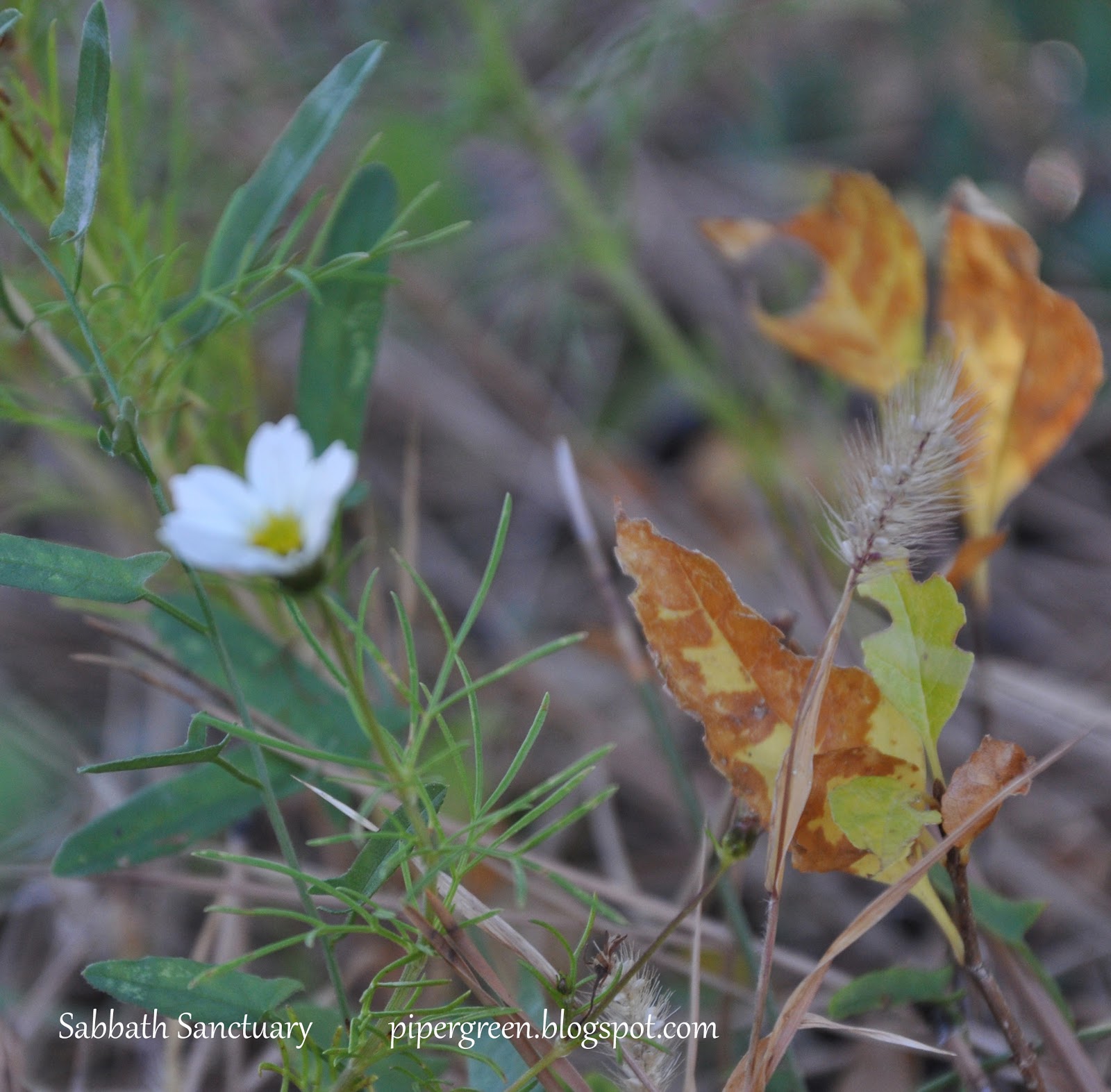
One wildflower shares my rebellious heart to hang on to dear life...

I love fall, it is my favorite season. The reds, oranges, and yellows are breath-taking here in Colorado; I catch myself wanting to walk the museum of God’s creation endlessly. Creation displays God’s glory and I want to bask in that glory for as long as I can. 


Truly, truly, I say to you, unless a grain of wheat falls into the earth and dies, it remains alone; but if it dies, it bears much fruit {John 12:24 NASB}.

Though I love fall, I know that it leads to winter; the cold, harsh, freezing, dark. A time when everything must die to make room for new life in the spring. Spiritually, winter is not an enjoyable season either, but God prunes us to grow more fruit, and though it is painful, new life will spring up in abundance. I purpose not to worry about the coming winter and enjoy the beauty of fall.

For by Him all things were created, both in the heavens and on earth, visible and invisible, whether thrones or dominions or rulers or authorities—all things have been created through Him and for Him. He is before all things, and in Him all things hold together {Col.1:16-17 NASB}.

In the beginning was the Word, and the Word was with God, and the Word was God. He was in the beginning with God. All things came into being through Him, and apart from Him nothing came into being that has come into being. In Him was life, and the life was the Light of men. The Light shines in the darkness, and the darkness did not comprehend it {John 1: 1-5 NASB}.

At sundown on October 17, the Jewish holiday of Simchat Torah began. It is a celebration of the Torah; the Word of God, and concludes the Feast of Tabernacles. For believers in Yeshua, it is a celebration of Him, the Word made flesh; He came and tabernacled with us. Simchat Torah  shares this evening-morning day with the Sabbath, a time to rest from all the distractions and worries of this world and turn our gaze upon the Lord.

This evening I lit two Sabbath candles to usher in the rest of God to my world, along with this blessing: 

Blessed are You, LORD our God, King of the universe, who sanctified us with His commandments, and commanded us to be a light to the nations and who gave to us Jesus our Messiah the Light of the world.


Then Jesus again spoke to them, saying, “I am the Light of the world; he who follows Me will not walk in the darkness, but will have the Light of life.” John 8:12 NASB


Jesus is the Light of the World. When life seems cold, harsh, and dark, Jesus is our Light and He will give us rest for our souls. 


When we focus on the cares of the world---our trials, the cross becomes blurry...


Rest your soul this weekend; create a Sabbath sanctuary in your world and allow Jesus to minister to your tired, weary soul. Let His light refresh you as you celebrate Him—the very Word of God, who tabernacles with you.